白露
2,200-year-old leaf-wrapped grain bundles found in Chinese tomb may be ancient precursor to ‘zongzi’_我的网站

A | CONCORD, N.H. -- The New Hampshire presidential primary filing period starts Wednesday, a ritual unruffled by either a changing of the guard or changes to the nominating calendar elsewhere.For the first time in more than four decades, candidates will file paperwork with a new secretary of state thanks to the retirement last year of longtime elections chief Bill Gardner. But his successor, David Scanlan, is carrying on the tradition of ensuring New Hampshire remains first, waiting for the dust to settle in other states before scheduling the 2024 contest.“I’m really in no hurry,” he said in an interview Tuesday.In contrast, the candidates themselves — particularly the longshots — often are in a race to sign up first in hopes that a bit of media attention will boost their campaigns. In 1991, a writer from New York drove 11 hours in a snowstorm only to find another perennial candidate waiting at the door. In 2007, a Minnesota fugitive living in Italy sent a package by courier that arrived just before an ex-convict embarked on a 90-minute rant that included five costume changes.Current candidates have until Oct. 27 to sign up, and dozens are expected to do in part because it’s relatively cheap and easy. They need only meet the basic requirements to be president, fill out a one-page form and pay a $1,000 filing fee.In 2020, 33 Democrats and 17 Republicans signed up. The all-time high was 1992, when 61 people got on the ballot. But this cycle could be notable instead for whose name isn’t on the ballot.New Hampshire, with its state law requiring its primaries to be held first, is defying the Democratic National Committee’s new primary calendar which calls for South Carolina to kick off voting on Feb. 3, followed by New Hampshire and Nevada. The shakeup came at the request of President Joe Biden in a bid to empower Black and other minority voters crucial to the party’s base.Biden’s campaign won’t comment on whether he will be on the ballot in New Hampshire. But he wouldn’t be the first reelection-seeking incumbent missing from the primary ballot: President Lyndon Johnson won the 1968 Democratic primary as a write-in, though a shockingly strong-second place showing by Sen. Eugene McCarthy helped push him out of the race.Scanlan, who served as deputy secretary of state for 20 years, said he was excited to welcome candidates starting Wednesday. Like his predecessor, he plans to greet them with a few encouraging words, but don’t expect the obscure trivia Gardner often added.“I don’t have any history lessons planned,” Scanlan said. “That was Bill’s style, and he was really, really good at it.”。
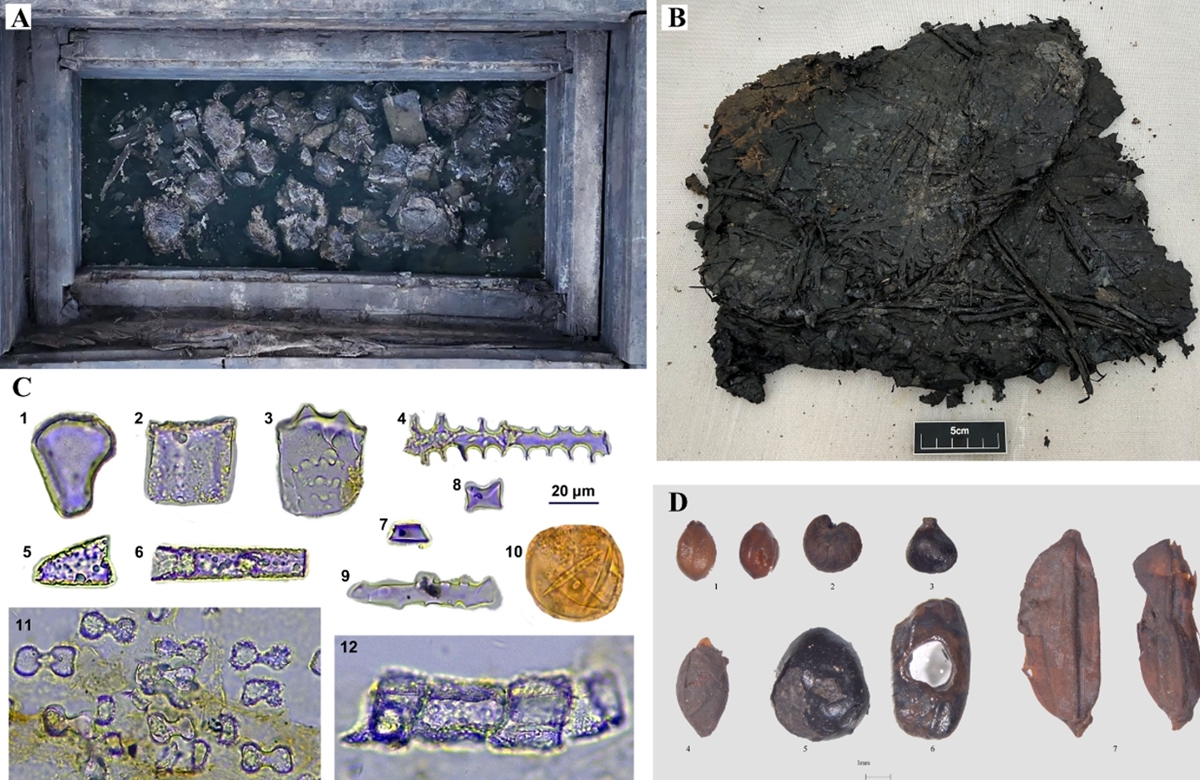
Photo: Courtesy of the Institute of Vertebrate Paleontology and PaleoanthropologyArchaeologists have unearthed a collection of plant-wrapped bundles dating back about 2,200 years that closely resemble modern-day
zongzi, the glutinous rice dumplings traditionally eaten during China's Dragon Boat Festival, according to a report by the Institute of Vertebrate Paleontology and Paleoanthropology (IVPP) under the Chinese Academy of Sciences (CAS). This study was published in the National Science Review.
In March 2024, archaeologists from the National Center for Archaeology excavated a large number of well-preserved, waterlogged plant bundles from the tomb's outer coffin chamber. On-site, the plant bundles could be seen tightly wrapped in broad leaves and tied with plant-fiber cords.
A team of researchers led by the National Center for Archaeology, IVPP, and the Chinese Academy of Social Sciences examined 12 of the bundles and found that the wrapping leaves came from oak trees, while the cords were made from grasses.
The bundles mainly contained rice, broomcorn millet, foxtail millet, and cereal seeds, most of which were still in their husks and mixed with inflorescence material. Small amounts of peppercorn, mallow and rice-field weed seeds were also found.
The fact that the bundles were found in a tomb and mainly contained grains still in their husks suggests they were not everyday food, but offerings intended for funerary rituals. "This might reflect a Warring States-era belief that grains served as wealth for the dead in the underworld," Ge Yong, an associate researcher at the IVPP and the study's corresponding author, told the Global Times.
A Qin Dynasty (221BC-206BC) text describes a belief that "soybeans were gold and millet was money" for the dead, indicating that grains held symbolic significance in funerary culture. "The bundles therefore appear to have been ritual offerings prepared for the deceased," Ge said, "not food for the living."
The physical structure of the bundles also resembles that of
zongzi, with grains wrapped in leaves and tightly secured with plant-fiber cords. "Similar practices of wrapping grains for burial have also been found elsewhere within the Chu cultural sphere," Ge said, "such as at the Chengyangcheng Site."
At the Chengyangcheng archaeological site in Henan Province, rice and broomcorn millet were also discovered wrapped in oak leaves. "An interesting fact is that we can still find
zongzi wrapped with the same oak leaves now in regions related to the Chu cultural sphere."
"The findings suggest that wrapping grains as funerary offerings was a relatively common practice in the Chu state during the Warring States period," Ge said. "And this practice may have been an early form of the
zongzi later associated with the legend of Qu Yuan."
These plant bundles share a structure similar to that of modern
zongzi and to those described in legends and folklore. This might reflect how, through cultural exchange and heritage, these 2,200-year-old plant bundles likely evolved over centuries, shifting from sacrificial offerings to food, said Ge.
As diverse regional populations adapted the practice, it eventually transformed into the well-known Dragon Boat Festival tradition of eating
zongzi. Thus, this structural resemblance might suggest a potential historical lineage; however, experts stressed that the Wuwangdun bundles should not simply be labelled as ancient
zongzi.
"We can't define these plant bundles as the earliest zongzi, but rather, we can confirm that by 2,200 years ago at the latest, the Chu region had established a tradition of using this specific form of plant bundles for funeral rites. And this tradition could be a possible origin or precursor of the well-known
zongzi," said Ge.
He added that the discovery provides critical physical evidence to explore the origins of
zongzi and its cultural heritage.
。
Current article:http://byey8hg.runtunpaixufenjuduishuang.pics/news/20260826_69351.html
Published on:13:09:31

 新区“烈焰战歌”预注册8月21日14点盛大开服
 China takes 97% of H1 global humanoid robot shipments; supply chains, vast market drive rapid scale-up, intl reach: expert
 湖人卖队有阴谋?新老板关系太硬,东契奇被无视?后者立马表忠心
 联想救世主轻追击笔记本预售:144HZ G-Sync屏幕,12999元
 "이진숙, 여자 전두환으로"…제명결의안 가결
 接举报“甲醛白菜”问题,中农批宿迁市场通报检测结果:在举报人见证下,两次检测均合格,市场内所有库存大白菜就地封存
 王欣解释了为什么“厕所山”这个名字来自刘德华的歌
 OpenAI模型,自主攻击全球最大AI开源平台


